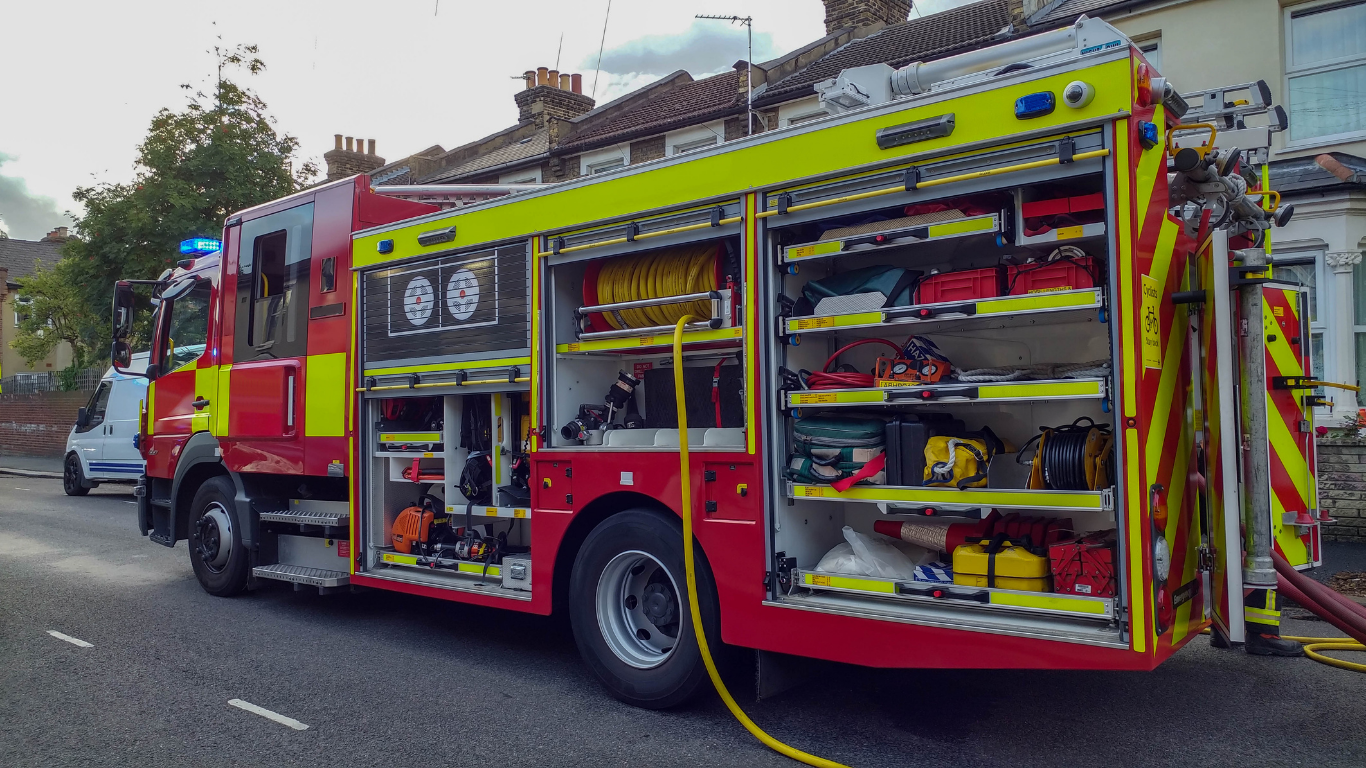
Overall, for the 3rd annual assessment of Fire and Rescue Services in England published on November 5th, 2025, the outcomes were good, with a high proportion of services seeing improvement across the following areas:
- Understanding the risk of fire and other emergencies.
- Preventing fires and other risks.
- Protecting the public health through fire regulation.
- Responding to fires and other emergencies.
- Responding to major and multi-agency incidents.
- Making best use of resources.
- Making the FRS affordable now and in the future.
- Promoting the right values and culture.
- Getting the right people with the right skills.
- Ensuring fairness and promoting diversity.
- Managing performance and developing leaders.
Of all Fire and Rescue Service authorities in England that take part in the annual assessment, the results of the 3rd review showed improvements, with 73% achieving adequate, good, or outstanding.

Fire and Rescue Service Innovation
Fire and Rescue Services are a significant area of ongoing innovation in the UK, with a great deal of innovative technologies being utilised to enhance better response times and reduce the risks to the public, while improving service efficiency. Some of the technology being used includes AI use, drones, tablets, and body cameras. The use of 5G technologies and data platforms for enhanced connectivity, and electric vehicles or high real turrets is also becoming more frequent.
In 2024, Fire and Rescue Services in Shropshire took leaps into digital innovations, with the integration of modern technology such as drones, live streaming cameras, and tablets. By mid-way through 2024, live streaming cameras had already been proven significant in tackling serious incidents.
In addition, the use of drones has been found to provide additional support to these services. Including:
- Real-time reconnaissance from the air to enhance faster situation awareness.
- Enhancements in mapping and visualisation of data to make more informed decisions.
- Faster development for locating missing individuals and addressing potentially hazardous environments.
- Speeding up response times.
Drones and other innovative technologies are making headway in the sector and are improving output for local Fire and Rescue Services.
Additionally, over the last few years, the London Fire Brigade have also been focusing on innovative technology to enhance its services. Their goals have been focused on vehicle enhancements such as the expansion of EV use, digital technologies that transform communications and aid intelligent data use, and sprinkler use encouragement.
Kent has also been advancing in their technology; in fact, in the last year, Kent Fire and Rescue Service have added a firefighting robot to its roster of technological innovation, helping teams manage risk, assess hazards, and assist with firefighting.
This new robot can conduct many firefighting tasks. It helps the teams to optimise their time when in firefighting situations. Having this assisting robot in place can enhance performance, therefore save lives and prevent hazardous situations from escalating. Fitted with thermal detection capabilities, it can give instructions, and it’s fitted with its own water dispersion system. It can assist with removing individuals from dangerous areas using a stretcher. This is reported to be one of the first instances of a firefighting robot use in UK firefighting and has the potential to be a critical development in efficiency and strategic optimisation for Fire and Rescue Services in the UK.

IESE Observations for Fire and Rescue Services
Over the years, IESE has seen fantastic transformation and improvements to service delivery from multiple Fire and Rescue Services.
Over the past ten years, one organisation stood out for their efforts and has achieved positioning in the IESE Hall of Fame. East Sussex Fire and Rescue Service (ESFRS) have worked hard at their development and transformation and has won awards in 2017 and 2022.
ESFRS highlighted how they viewed the opportunity of obtaining Hall of Fame IESE Award status as an opportunity for sharing ideas and benchmarking.
East Sussex Fire and Rescue Service have been working to collaborate with several GP practices to share patient contact details through data sharing agreements and patient consent. The administrative sharing of data provides GP practices with details of home conditions, especially in instances where home conditions have the potential to risk poorer health outcomes, such as cold and damp homes.
This came after an analysis of the data of those who were most at risk, which critically showed that the most vulnerable to fires and in need of these services also typically happened to be vulnerable persons who were or had been supported by Adult Social Care services in the surrounding areas.
Through thorough teamwork, ESFRS collaborated with East Sussex County Council to arrange data sharing, reaching out to the individuals most at risk for consent of this. This data sharing enables the teams to conduct Home Safety Visits with the client’s consent to do so.
Identifying vulnerable people in this bracket also led to an agreement with Adult Social Care services in the region, who proceeded to change the questions asked to those receiving social care services and added a mandatory question about consent to share contact information with agencies (such as FRS) to make them safer.
This pathway was adopted following ESFRS’s assessment that the increased risk of injury or fatality in a fire should not be contingent on pressured services remembering, or having the capacity, to submit a referral to the Fire and Rescue Service. With credible alternative pathways such as information sharing, the process becomes administrative, not transactional and enables fast action and preventative measures.
“In the period before the visit, these patients collectively accounted for 244 visits to the GP. In the same length period following the visit, the same cohort accounted for 147 visits to GPs, 97 fewer visits – a reduction of 60%.
Neither the GP Practice nor ESFRS have been able to identify the reason for the reduction, but our home safety visit practitioners felt that it was likely that people felt safer in their home, had felt the visit made them less isolated and built their self-confidence.” – ESFRS
If your organisation is innovating with new technologies in Fire & Rescue Services, please get in touch and let us know about your creative approach at iese.org.uk.