DigiFest: Insights into Business & Technology
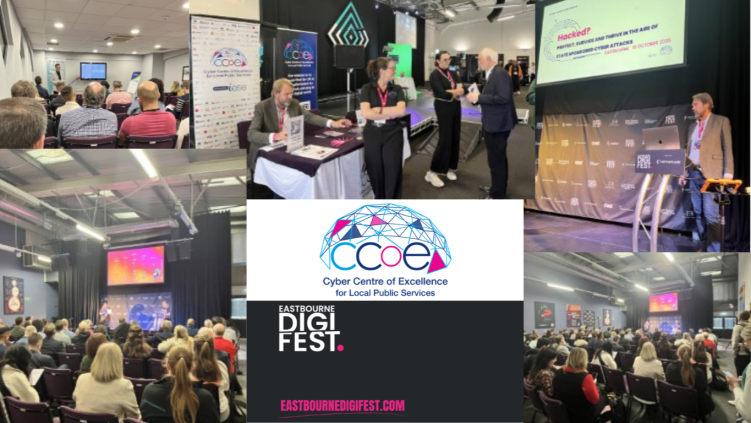
During October, IESE accompanied their CCoE (Cyber Centre of Excellence) colleagues and attended Eastbourne DigiFest, an event with a variety of exhibitors ranging from VR to technology uses in the medical world, and even a chocolate stall. CCoE also had the opportunity to showcase their expertise in cyber security solutions and highlight what small businesses and sole trader can be doing to optimise their protection. Alongside the wide range of exhibitors, there were 3 different stages with various speakers all day, providing a diverse and informative program of talks and lectures. This event provided plenty of networking opportunities to gain insight into just how technology and business are integrating.
Around the event, there was a great deal of discussion on the importance of communication around cyber technology use, cyber security, business applications and innovation, as well as the adaptation of industries to the ‘AI revolution’, with many discussing if it is similar to the .com bubble or not.
Talk 1 – Beyond Assumptions: How Customer Insights Drive Product Success
One of the key takeaways from this talk was the notion that “Innovation fails when it ignores how people feel”. This highlighted the importance of customer feedback as trust rather than just data. Identifying the importance of building relationships with customers and understanding needs beyond the baseline.
The speaker, Mr Raffael Di Meo, discussed three key points during his talk;
- The importance of field studies. They are only useful when conducted effectively; for example, any digital product, such as an app or mobile device, should be studied at all times of day and all locations, as they will be used in the office, at home, and even at night.
- The critical use of user interviews. Specifically using available data to answer basic questions such as who is using your product and why, to then ask the user themselves more targeted and useful questions.
- Usability testing by giving prototypes to users and observing the ease of use, functionality and user experience.
Raffael Di Meo concluded his talk by reemphasising key Do’s and Don’ts. His most prominent point was to not take positive feedback at face value; you must dig deeper and ask ‘Why?’ so you can gain a more in-depth analysis and identify the key selling points of any product.
Talk 2 – Leading People in the Age of AI
This talk was given by Paul Hetherington; he initially discussed if the AI revolution was like the .com bubble or not. He emphasised that he did not agree but countered his own argument with the fact that some businesses, such as Amazon and Google, thrived from the .com bubble. So why would some AI companies not thrive in a similar situation?
The most unique analysis in this talk was comparing the ‘Age of AI’ to the agricultural revolution. The comparison here was that before the agricultural revolution, nearly 100% of the population would have been employed by the agricultural industry, and afterwards, this was greatly reduced. However, there was no extreme unemployment, as new jobs came about as a result of the revolution. In this sense, he believes AI won’t take people’s jobs away, but provide a new calibre of jobs as a result of the AI revolution.
Paul explained that he has 6 rules for AI, which are as follows:
- Do not bury your head in the sand; AI is happening.
- It is important to lead people and manage things, where AI can help your business as long as you have coherent AI policies.
- DO delegate and DO NOT abdicate. IT and HR departments need to report to the CEO or owner, who must be involved in all decisions.
- It is important to reward AI innovators and protect them. If they innovate well enough that their role becomes redundant, promote them, don’t fire them.
- It is critical to seek help and expertise; research is essential when dealing with new technology.
- People and purpose, people are important, and AI is just a tool. Imagine AI is the storm and the organisation is the plane. You cannot change the weather, but you can charter the course of the plane.
This talk finished off by highlighting the way in which AI may alter the employment market. It was proposed that there will be a shift away from Intelligence Quotient (IQ), which can be taken over by AI, and a focus on emotional intelligence (EI), which will be more important in maintaining humanisation and customer sensitivity.
Talk 3 – Responsible AI: The Role of Ethics, Regulation and Governance
The next talk was given by Mr Glenn Cilcott, who is currently studying and completing a MA in Responsible AI use, alongside his highly qualified 27+ years of corporate IT and investing experience.
Glenn began his talk by asking attendees how they feel about AI, and if there is a feeling of missing out or being left behind due to the overwhelming continuance of change in technology. According to Glenn and his research, around 90% of leaders stated AI is essential for successful leadership, but less than 20% felt confident in their AI knowledge.
He hypothesised that it is likely we are in the 4th revolution, and this is reflected in the stock market, which used to be saturated with gas and oil but is now saturated with AI and technology. Glen also made the comparison of AI to the .com bubble, but focused on the way in which this is different and how there needs to be more regulation around data collection and storage, as well as policy and protection. It is clear that safe and secure use of AI in cyber security is the area which businesses find the most challenging. Things that could be attributed to human oversight in decision-making, but will now be blamed on AI use, can be detrimental and damaging and therefore it is critical for businesses, local authorities and central government to ensure that these areas have ethical and legal protections in place.
Glenn also highlighted the importance of international understanding of AI regulations. Currently, the USA, China and Europe are all creating independent regulations, meaning there with be 3 different sets of rules for use. To avoid confusion and make sure AI is used safely and responsibly by all, an International and Global AI policy needs to be made with clear regulations in place.
A key takeaway from Glenn’s talk is that AI is a learning system as well as an intelligent one; therefore, it will learn unconscious prejudice and biases in data. Understanding limitations and awareness of data sensitivity has to be highlighted to ensure that it is used safely. Businesses should also ensure they have the right policies and training in place for AI use, as Glenn’s research highlights how many of us still don’t feel ready.
Talk 4 – Hacked? What to do to Prevent, Survive and Thrive in a world facing cyber security threats everywhere
Andrew Larner’s, CCoE Advisory Board member, led a talk on software and applications for both home and workplace environments that help individuals and organisations stay safer. For example, he highlighted devices that, when connected to a Wi-Fi router, create two secure networks – one dedicated to business use and the other for personal use.
As Andrew Larner’s previous experience is in local government, he spoke about the cyber attacks on the London Borough of Hackney and Redcar and Cleveland Councils, which, despite occurring several years ago, continue to have lasting impacts. Both authorities are still working to recover lost data and have faced a combined financial cost of around £10 million, highlighting the critical importance of robust cyber security practices. Additionally, Andrew anticipates that with technological advancements, cyber attacks will only continue to increase in number and complexity. This is especially true with the first official AI-generated malware surfacing in 2025.
“Essentially, what is happening is we have got a bigger and bigger gap between what we have got to protect ourselves and what is coming at us” – Andrew Larner.
A further point made by Andrew was how small businesses with less than 10 employees are at even higher risk of cyber attacks than the larger businesses, as small businesses are less likely to have the cyber security infrastructure of larger corporations, and so are easier targets for cyber attacks.
Key Takeaway from DigiFest
The main takeaway from DigiFest is that while technological advancements and AI growth may seem intimidating, it is an opportunity for further growth. However, employers need to be aware of what this means, the effectiveness and limitations of this technology, and maintain awareness of the risk. AI is also not going to cause unemployment in the long term but instead open new opportunities – it just means retraining and adapting to the changing technological and economic climate.
Cyber security is key in all sectors, and awareness of AI with coherent regulations in place for use is essential to ensure technological advancements that can boost any business. A final key point from DigiFest is to be aware of the risks of this technology and be sure to protect yourself, implementing adequate cyber security at home and at work, regardless of business size, as your data is worth protecting.
For more information on how DigiFest or how CCoE can help you optimise your cyber security, visit the CCoE website: www.ccoe.org.uk.