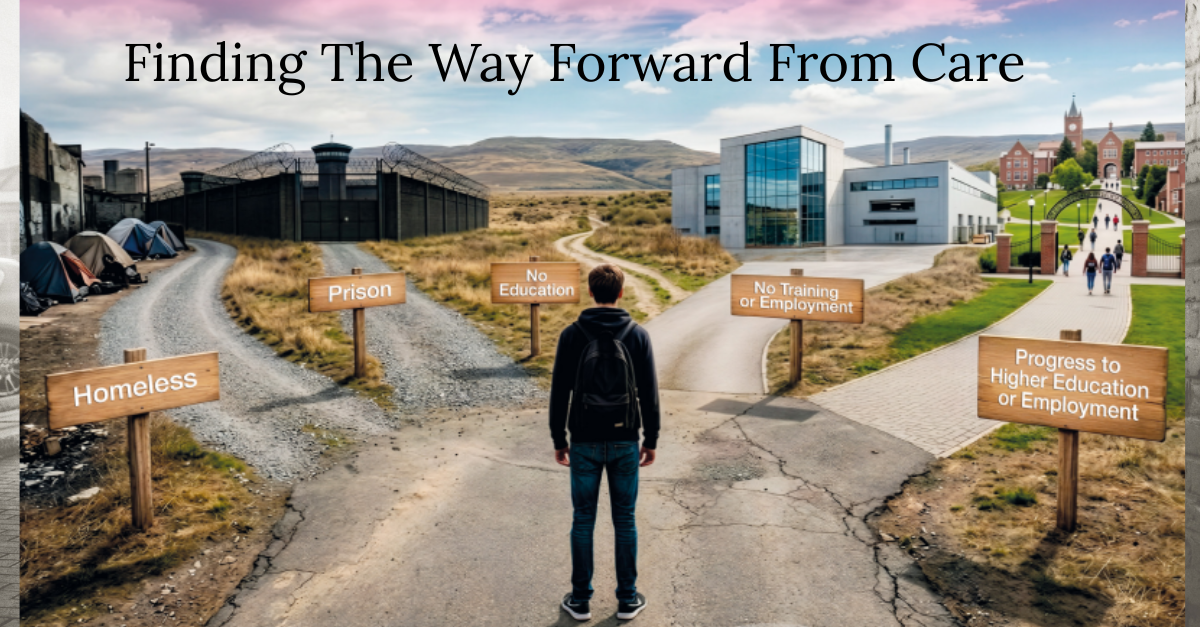
Care leavers in the UK face many challenges, with the cost-of-living showing no signs of easing. Meanwhile, the job market for younger people is experiencing significant strain, with nearly 1 million young people classified as Not in Education, Employment or Training (NEET) by the end of 2025. For those leaving young persons’ care, this is an exceptional challenge to overcome.
After the Department for Education (DfE) published a report for the 2023/2024 year, noting that care leavers generally experience worse outcomes than their peers across a variety of areas, this was identified as a longstanding problem that brings high public cost.
Following the 2021 independent government review of children’s social care, an implementation strategy and consultation on children’s social care reform was produced. This followed staggering data around the risks to fulfilment which care leavers often experience. This included statistics that showed at the time of the report:
- Children who have been in care comprised 25% of the homeless population.
- Children who have been in care comprised 24% of the prison population.
- 39% of care leavers were not in education, employment or training, in comparison to 13% of all 19–21-year-olds.
- Only 13% of care leavers progressed to higher education by age 19, compared to 43 % of other young people.
Care Leavers Support
Since 2014, local authorities have been required to provide financial support to enable young people who are in foster care to remain living with their foster family until the age of 21. Furthermore, local authorities are also required to appoint a personal adviser (PA) to young people leaving care to help them plan for their futures. This support is available for all those who are leaving care up until the age of 25.
When it comes to additional financial support, care leavers who wish to pursue university studies are eligible to apply for a bursary of up to £2,000. There are specific requirements regarding eligibility for financial support, enabling care leavers to access training, employment, and educational opportunities. This forms part of the leaving care grant of £2,000, designed to help young people furnish their first home and support their transition to independent living.
In early March 2022, the BBC publicly reported on the findings of King’s College London research on the impact of this financial support for young people. This research concluded that care leavers who were provided with a £2,000 support payment upon leaving care had a reduced likelihood of spending time in hospital or prison and reduced the risk of homelessness.
This research was funded by the UK government in 2023, and all participants were required to fill out a survey before 100 were randomly identified to receive this grant. A follow-up comparison between those who received the grant and those who did not revealed a clear impact and positive effect of this support.
Identifiable points of impact included that those who received the financial assistance had a higher likelihood of being in stable accommodation and less likely to be sofa surfing. They were also less likely to have criminal convictions, were less likely to have overnight hospital stays, and were more likely to visit GPs or drop-in clinics.
Furthermore, the results of the study also highlighted that those who received this support spent 12% less on dangerous substances than previously.
The findings of this study were very encouraging and showcased the importance of continued support for care leavers and how a one-off support payment can provide a ladder to independence.
These efforts to increase the quality of life and independence in care leavers are specific to those aged between 16 and 25. This is only available for those who are currently or who have been in care, or who have been looked after by an English local authority.
Hippo Digital & DfE: Care Leaver Digital Support Service
Innovation in the sector is key to helping care leavers to access essential support and services, and alongside the UK Government’s support schemes and financial assistance, those who are eligible for this support must know how to access it. Hippo Digital and the Department for Education worked together to innovate a service that enables 88,000 vulnerable care leavers per year, ages 16 to 24, to have better access to digital information regarding their available support. This was a project that came from recognition that the poor outcomes faced by this demographic could be mitigated through better access to essential information.
The project was created to help ensure information is accessible to all care leavers, as statistics showed care leavers face poor societal outcomes, with a third becoming homeless within just two years of leaving care, and a quarter of the prison population having been in care at some point in their lives. Hippo Digital and DfE believed awareness of the support available may be a barrier that needs to be eliminated. After investigating if this was the case, they found the information surrounding support was not easy to access, particularly for those who do not have English as a first language or who may require printed copies, and there was inadequate signposting to support charities and government systems.
The accessibility issues they found were compounded by the fact that a quarter of care leavers do not have English as their first language, often having arrived in the UK as unaccompanied asylum-seeking children, thus adding further challenges to these individuals who need help when leaving care.
Hippo Digital and DfE, in collaboration, concluded that the solution to be a new website, a concept specifically crafted to be accessible for individuals with a low reading age. The newly designed website functions as a definitive and easily accessible source of support-relevant information for care leavers in the UK. Consolidating essential support information, eligibility checker flows and a comprehensive list of available helplines for a myriad of critical services ranging from mental health support services to domestic abuse services. This innovative idea provides care leavers with the knowledge they need to understand their legal rights.
Shortly after going live, the project bore fruit and had a substantial increase in traffic, with the previous site getting an average of 1,000 views per month; the new site gets more than 10,000, showing that the site is reaching more people.
Furthermore, work was conducted with the Ministry of Justice to get the Care Leavers site added onto the whitelists in incarcerated settings, to ensure that those who are in Young Offenders Institutions have access to support information before they leave these settings and help to reduce the likelihood of reoffending.
The site is also embedded with ground-breaking multilingual support using Microsoft AI Translate to instantly translate the site content into an impressive 120 languages. This is a feature that ensures that the quarter of care leavers who do not have English as a first language are still able to obtain and understand the vital information they need. The translation service includes contextual meaning, providing high-quality information, whereas beforehand there was little to none.
Following the work by Hippo Digital and DfE, alongside the research conducted by Kings College London, we can see that a primary barrier to success for those leaving care has been access to necessary information about the support available to them. Furthermore, the support available for care leavers, when fully utilised, can have a massive impact on the opportunities these individuals have, and the quality of life they can lead.
The work of these organisations show that innovation and investment in support services is a critical step forward to success after social care.
If your organisation is investing in innovations to help improve life after social care in the UK, tell us about your creative approach at iese.org.uk.